
House Construction Cost in Nepal (2026): Price Per Sq. Ft. & Total Budget
A complete 2026 guide breakdown of house construction costs in Nepal. Covers per sq. ft. pricing ranges across Basic, Standard, and Premium tiers, structural versus finishing material breakdowns, foundation costs, regional price differences between Kathmandu Valley and outer cities, and a milestone cash flow guide tailored for Nepalis sending remittances from abroad.
1. Navigating Residential Construction in Nepal
Building a home in Nepal is one of the most significant financial investments a family will ever make, particularly for Non-Resident Nepalis (NRNs) who manage their budgets remotely from countries like Australia, the United States, the United Kingdom, Canada, Japan, and the Gulf region. The core question every homebuyer asks before transferring their hard-earned money back home is remarkably consistent: "How much money do I actually need to send home to build and complete my house?"
In 2026, navigating the house construction cost in Nepal requires a clear understanding of current market dynamics, raw material price fluctuations, labor charges, and the structural requirements mandated by local municipal codes. Whether you intend to build a simple two-storey residence or an expansive modern family home, establishing a realistic budget from the very beginning is the single most effective way to prevent project delays, unexpected cost overruns, and dispute risks with contractors.
To plan your finances accurately, you must first distinguish between a bare structural build, commonly known as a grey structure, and a turnkey full-finishing project. A grey structure covers the earth excavation, foundation work, Reinforced Cement Concrete (RCC) frame including columns, beams, and slabs, alongside brick masonry walls and basic plastering. On the other hand, full-finishing encompasses all the surface finishes that make a house liveable, including floor tiling, bathroom sanitaryware, door and window installations, interior and exterior painting, electrical wiring, and plumbing fixtures. Many overseas buyers fall into financial traps because they receive a low initial quote per square foot from a local contractor, only to realize later that the figure covered strictly structural elements while omitting essential finishing items, municipal approval fees, and utility connections.
The full construction scope in Nepal is fundamentally divided into two main categories: the Grey Structure and the Complete Turnkey Finish. The Grey Structure refers to the essential structural work, including soil excavation, foundation footings, RCC columns, beams, and slab casting, alongside brick masonry, plastering, and the installation of conduits for electrical and plumbing systems. In contrast, the Complete Turnkey Finish covers the final aesthetic and functional elements that make the house move-in ready, such as flooring tiles and granite, complete sanitaryware, door installations, UPVC or aluminum windows, electrical wiring and switches, and both interior and exterior painting.
2. Benchmark Rates Per Square Foot
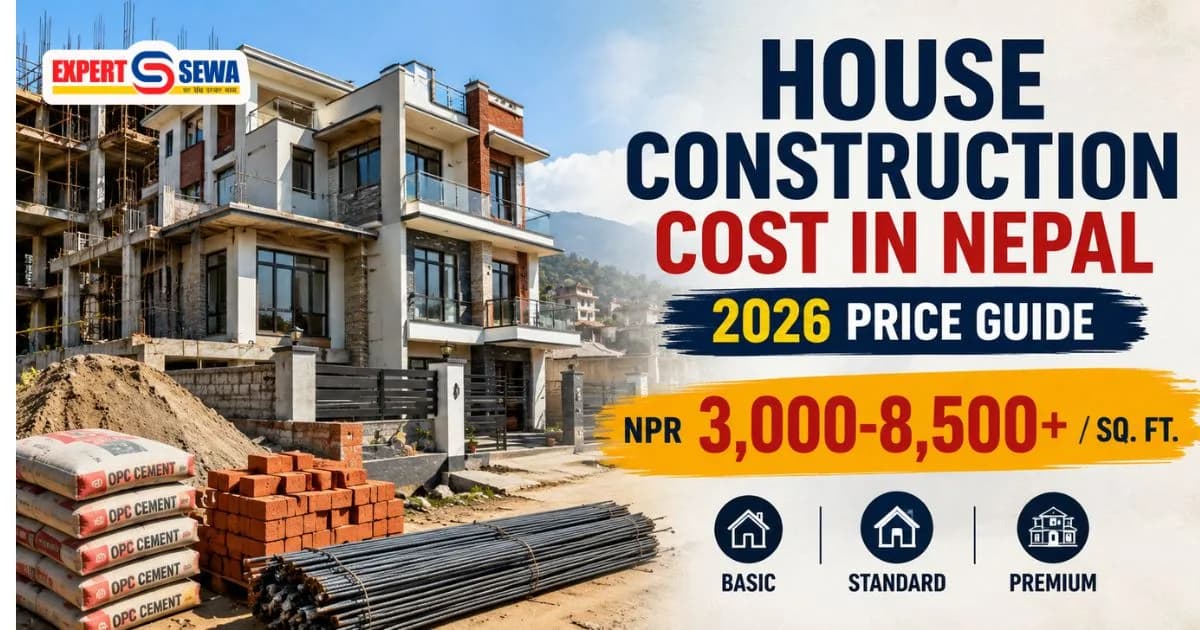
The overall house construction cost in Nepal per square foot is broadly classified into three quality tiers: Basic, Standard, and Premium. For a Basic or budget-level build in 2026, homebuilders should expect to spend between NPR 3,000 and NPR 3,800 per square foot. This tier is best suited for rental properties or simple rural residences, utilizing local floor tiles, basic sanitaryware, local brick masonry, and standard paint finishes. While functional, it provides limited customization and basic aesthetic choices.
The Standard or mid-range quality tier represents the most popular choice for urban family homes in Kathmandu, Lalitpur, Pokhara, and Chitwan, ranging from NPR 4,000 to NPR 5,800 per square foot. This tier utilizes high-grade materials, including branded OPC and PPC cement, certified TMT Fe 500D steel rebar, 600x600 mm vitrified floor tiles, double-glazed UPVC windows, quality CPVC plumbing, and premium weather-shield exterior paints.
For buyers seeking architectural luxury, the Premium tier ranges from NPR 6,000 to NPR 8,500+ per square foot. This option incorporates luxury finishes such as imported Italian marble, hardwood flooring, false ceilings, modular kitchens, designer bathroom fixtures, solar utility setups, and toughened glass railings.
Construction Quality Tier | Estimated Rate per Sq. Ft. (NPR) | Best Suited For | Key Specifications Included |
Basic / Budget | NPR 3,000 – NPR 3,800 | Rental properties, simple homes | Local grade tiles, basic sanitaryware, standard brickwork, single coat paint. |
Standard / Mid-Range | NPR 4,000 – NPR 5,800 | Standard 2.5-storey family residences | Branded OPC/PPC cement, TMT Fe 500D rebar, 600x600 vitrified tiles, UPVC windows, emulsion paint. |
Premium / Luxury | NPR 6,000 – NPR 8,500+ | High-end luxury residences | Granite/marble flooring, imported fixtures, modular kitchen, false ceilings, toughened glass balconies. |
3. Total Budget Estimates by Common House Sizes
To contextualize what these per-square-foot rates mean for your total financial commitment, it helps to examine total built-up area calculations across common Nepalese home sizes. A compact 1,000 square foot home, typically designed as a single-storey structure or a compact 1.5-storey floor plan, requires a total budget between NPR 40 Lakhs and NPR 50 Lakhs for a standard level of finish. Within this budget, structural work accounts for approximately NPR 22 Lakhs to NPR 28 Lakhs, while finishing materials and installations make up the remaining NPR 18 Lakhs to NPR 22 Lakhs.
The most sought-after residential layout across Kathmandu Valley and major metropolitan areas is the standard 2.5-storey family home, which generally features a total built-up area of 1,500 square feet. Building a home of this size to standard specifications in 2026 requires an estimated investment between NPR 60 Lakhs and NPR 75 Lakhs. For larger families or those who desire spacious living quarters spread across 2.5 to 3 storeys with a built-up footprint of 2,000 square feet, the total construction cost ranges from NPR 80 Lakhs to NPR 1 Crore. It is vital to remember that these baseline figures apply directly to the house structure itself and exclude land purchasing costs, boundary wall construction, deep water boring, and municipal permit fees.
Total Built-Up Area | Typical Storey Layout | Estimated Structural Cost (NPR) | Estimated Finishing Cost (NPR) | Total Estimated Budget (NPR)* |
1,000 Sq. Ft. | Single Storey or Compact 1.5 Storey | NPR 22 Lakhs – NPR 28 Lakhs | NPR 18 Lakhs – NPR 22 Lakhs | NPR 40 Lakhs – NPR 50 Lakhs |
1,500 Sq. Ft. | Standard 2.5 Storey Home | NPR 33 Lakhs – NPR 42 Lakhs | NPR 27 Lakhs – NPR 33 Lakhs | NPR 60 Lakhs – NPR 75 Lakhs |
2,000 Sq. Ft. | Spacious 2.5 to 3 Storey Home | NPR 44 Lakhs – NPR 56 Lakhs | NPR 36 Lakhs – NPR 44 Lakhs | NPR 80 Lakhs – NPR 1 Crore |
*Note: Figures exclude land purchasing costs, compound walls, deep boring, and municipal permit fees.
4. Per-Square-Foot Rates: Inclusions and Exclusions
When analyzing a quote for the total house construction cost in Nepal, you must carefully inspect the contract terms to understand what is included in the base rate and what will be billed as an extra charge. A standard, transparent per-square-foot contract from a reputable engineering firm includes the complete earthwork excavation, footing construction, RCC columns and beams, slab casting, brick partition walls, double-coat plastering, standard ceramic or vitrified floor tiling, basic CPVC/PVC plumbing lines, concealed electrical copper wiring, and basic interior emulsion painting.
Conversely, several peripheral works are almost universally excluded from standard per-square-foot building contracts and must be budgeted separately. Municipal drawing approvals, known locally as the Naksha Pass process, alongside soil testing fees, structural engineering certification, and municipal taxes, can add between NPR 1.5 Lakhs and NPR 3 Lakhs to your upfront expenditure. Furthermore, site preparation requirements such as deep boring for water extraction, underground water storage tank construction, septic tank installation, compound perimeter walls, main iron entrance gates, decorative interior woodwork, modular kitchen cabinets, and landscaping are treated as separate items. Failing to account for these exclusions early in your financial planning is the primary cause of mid-project cash flow shortages.
5. Material and Labor Cost Breakdown
Understanding the internal expense distribution of a residential construction project allows homeowners to evaluate quotes critically and manage resources effectively. In Nepal, raw materials account for the largest share of your budget, making up roughly 55% to 65% of total expenditure. Labor costs represent approximately 25% to 35% of the total budget, while contractor management, technical supervision, and company overhead make up the remaining 10% to 15%.
The cost of essential building materials in 2026 reflects prevailing market conditions across Nepal. High-grade Ordinary Portland Cement (OPC), which is essential for heavy structural column and slab casting, ranges from NPR 750 to NPR 950 per 50 kg bag, with recognized brands including Shivam, CG, and Sagarmatha.
Portland Pozzolana Cement (PPC), used primarily for brick masonry wall construction and plastering, costs between NPR 650 and NPR 820 per bag. Thermo-Mechanically Treated (TMT) steel rebar of Fe 500D grade, sourced from manufacturers like Panchakanya, Jagdamba, or Ambe, ranges from NPR 88 to NPR 110 per kilogram. Meanwhile, Class-A red bricks in Kathmandu Valley average NPR 16 to NPR 20 per piece, river sand costs between NPR 3,200 and NPR 4,000 per cubic meter, and crushed stone aggregate runs between NPR 3,500 and NPR 4,200 per cubic meter. Daily labor rates in urban centers average NPR 1,500 to NPR 2,000 for skilled masons and steel fixers, while unskilled site helpers earn between NPR 900 and NPR 1,200 per day.
Material / Resource | Unit | Average Market Price 2026 (NPR) | Notes |
OPC Cement | 50 kg Bag | NPR 750 – NPR 950 | Brands: Shivam, CG, Sagarmatha, Ambe |
PPC Cement | 50 kg Bag | NPR 650 – NPR 820 | Brands: Hongshi, Shivam PPC, Ambe PPC |
TMT Steel Rebar (Fe 500D) | Per Kg | NPR 88 – NPR 110 | Brands: Panchakanya, Jagdamba, Ambe |
Class-A Red Bricks | Per Unit | NPR 16 – NPR 20 | Local Kathmandu Valley kiln rates |
Sand | Per Cu.m. | NPR 3,200 – NPR 4,000 | Varies by quarry source and transport distance |
Aggregate (20mm) | Per Cu.m. | NPR 3,500 – NPR 4,200 | Roshi / Melamchi quarry sources |
Skilled Mason / Laborer | Daily Rate | NPR 1,500 – NPR 2,000 | Kathmandu Valley rates |
Unskilled Laborer | Daily Rate | NPR 900 – NPR 1,200 | Site helper rates |
6. Substructure and Foundation Analysis
The foundation, or substructure, represents the most critical structural component of any house in Nepal, directly determining its seismic resilience and long-term stability. The cost of foundation construction typically accounts for 15% to 25% of the total grey structure budget, though this figure varies depending on soil composition, water table depth, and plot slope. Standard isolated or strip footings are suitable for stable soil conditions, but plots featuring soft soil or steep hillside slopes require deeper mat foundations, isolated raft foundations, or deep pillar footings, which naturally increase material and labor expenses.
A standard foundation build involves soil excavation, laying a Lean Concrete or Poor Concrete Cement (PCC) bed, installing heavy steel rebar mesh for footing mats, constructing RCC column footings, casting ground tie beams, and applying a Damp-Proof Course (DPC) layer. The DPC layer is essential for preventing underground groundwater from seeping upward into your ground-floor walls and causing masonry dampness, plaster peeling, and paint damage in subsequent years. Investing in structural engineering and proper foundation design ensures that your building complies fully with Nepal National Building Code guidelines (NBC 105:2020) for earthquake resistance.
7. Detailed Finishing Work Cost Breakdown
Finishing work accounts for nearly half of the total house construction cost in Nepal, giving homeowners significant flexibility to scale their expenses up or down based on personal taste and financial capacity. Flooring choices represent a major variable item within this category. Standard vitrified ceramic tiles cost between NPR 120 and NPR 250 per square foot for material supply and installation, whereas fitting high-end Indian or Italian granite or natural marble on staircases and main living rooms elevates the cost to NPR 350 to NPR 800+ per square foot.
Flooring and tiling constitute the largest portion of the finishing budget at 25% to 30%, followed by doors and windows using UPVC, which account for 20% to 25%. Sanitaryware and plumbing installations represent 15% to 20% of the costs, while electrical and lighting fixtures make up 12% to 15%. Finally, interior and exterior painting consumes 10% to 12% of the total finishing budget.
Windows and doors represent another major expenditure during the finishing phase.
Modern homeowners in Nepal increasingly prefer UPVC (Unplasticized Polyvinyl Chloride) window frames over traditional timber or basic aluminum due to their superior thermal insulation, soundproofing capabilities, and water resistance during monsoon rains. double-glazed UPVC windows cost between NPR 450 and NPR 800 per square foot installed. Plumbing lines using premium CPVC pipes, paired with sanitaryware like wall-hung toilets, washbasins, and shower mixers from brands such as Jaquar, Hindware, or Kohler, add approximately NPR 1.5 Lakhs to NPR 3.5 Lakhs per bathroom. Finally, electrical installations using fire-resistant copper wiring from Litmus or Havells, paired with modular switch plates and LED lighting, typically cost between NPR 1.5 Lakhs and NPR 3 Lakhs for a standard 2.5-storey home.
8. Regional Price Variations Across Nepal
The geography of Nepal introduces price variations across different cities and districts. The overall house construction cost in Nepal's metropolitan hubs namely Kathmandu, Lalitpur, and Bhaktapur—is roughly 10% to 20% higher than in cities located across the Terai belt, such as Chitwan, Butwal, Biratnagar, or Birgunj. This regional price gap is driven primarily by higher daily labor wages, stricter municipal regulations, higher municipal permit fees, and tight inner-city site access constraints in Kathmandu Valley, where large material supply trucks face restricted delivery hours.
In scenic valley cities like Pokhara, construction costs remain comparable to Kathmandu due to high local demand and strict municipal building codes designed to preserve urban aesthetics and environmental safety. Conversely, building in remote or hilly districts outside major road corridors introduces substantial logistics surcharges. Transporting cement, steel rebar, tiles, and aggregate over winding mountain roads can increase raw material delivery fees by 15% to 30%, highlighting the importance of working with local material suppliers and regional construction management teams.
9. NRN Milestone Payment Release Schedule
For Non-Resident Nepalis managing a project from abroad, releasing construction funds in controlled, milestone-based installments is the single best way to maintain financial security and ensure steady site progress. Paying a contractor a large upfront lump sum introduces significant risk, as it reduces your leverage if work stalls or quality falls short of contractual standards. Instead, structure your contract around a clear 6-stage payment release schedule tied to verified engineering milestones on site.
The NRN milestone payment schedule is structured across six distinct stages to ensure financial security and consistent site progress. It begins with a 10% mobilization deposit upon contract signing and initial site setup. This is followed by a 20% release for the foundation and DPC stage, contingent upon structural engineer inspection approval. A 25% payment is then due for the structural RCC frame, which includes columns and slabs, verified by concrete cube tests. Upon the completion of internal and external brickwork and plastering, a further 20% is released. The fifth stage allocates 20% for finishing tasks and utilities, including the installation of tiles, windows, and plumbing. Finally, a 5% retention fee is held as a security deposit until 30 days after the key handover to ensure any minor operational defects are fully resolved before final settlement.
A recommended payment schedule begins with a 10% mobilization advance upon contract signing and initial site setup. Once earthwork excavation, foundation footings, and ground tie-beams are cast and inspected by a qualified civil engineer, a second payment of 20% is released. The third milestone, comprising 25% of the contract value, funds the main RCC structural frame, including columns and slab casting across all floors, verified by concrete cube compression tests. The fourth payment of 20% covers complete brick masonry and plastering, while the fifth installment of 20% funds finishing tasks such as tiling, UPVC window installation, plumbing, and electrical work. Finally, a 5% retention fee should be held for 30 days after final key handover to ensure any minor operational defects are fully corrected before final settlement.
10. Cost Reduction Strategies Without Sacrificing Quality
Reducing your total house construction cost in Nepal does not mean compromising structural integrity or seismic safety. Rather, it involves making informed design choices and eliminating unnecessary architectural complexity. One of the most effective ways to lower expenses is to optimize your building's structural geometry. Simple rectangular or square floor plan layouts with uniform column grids require less steel rebar, simpler formwork shuttering, and lower labor hours compared to complex floor plans featuring numerous wall cantilevers, decorative curved slabs, and irregular angles.
Another practical strategy is to select materials based on their specific structural functions. For example, while high-grade OPC cement is necessary for structural column and beam casting, switching to quality PPC cement for wall brickwork and plastering can yield noticeable savings without sacrificing quality, as PPC offers excellent workability and reduces shrinkage cracking. Additionally, purchasing key finishing materials like tiles, sanitaryware, and electrical fittings in bulk directly from major regional distributors—rather than buying piecemeal from small local retail shops—allows you to negotiate significant volume discounts. Lastly, securing a detailed Bill of Quantities (BOQ) with fixed material specifications prior to signing a contract prevents mid-construction scope changes and protects you from unexpected price inflation.
11. Frequently Asked Questions
Q1: What is the average house construction cost in Nepal per sq. ft. in 2026?
A: In 2026, building a house in Nepal costs between NPR 3,000 and NPR 6,500+ per sq. ft. A basic finish ranges from NPR 3,000 to NPR 3,800/sq. ft., a standard finish runs between NPR 4,000 and NPR 5,800/sq. ft., while premium luxury construction starts at NPR 6,000/sq. ft. and can exceed NPR 8,500/sq. ft. depending on imported materials.
Q2: How much does it cost to build a standard 2.5-storey house in Kathmandu?
A: A typical 2.5-storey residential home in Kathmandu with a total built-up area of 1,500 to 1,800 sq. ft. costs between NPR 65 Lakhs and NPR 95 Lakhs for complete construction with standard finishing. This price excludes land acquisition, boundary walls, and municipal permit fees.
Q3: What items are usually excluded from a contractor's per sq. ft. estimate?
A: Standard per-square-foot quotes usually cover the RCC structure, brick masonry, plastering, basic tiling, and standard plumbing/electrical conduits. They generally exclude municipal approval fees (Naksha Pass), soil testing and structural engineering fees, deep boring, septic tanks, water storage tanks, compound walls, main entrance gates, interior woodwork, modular kitchen cabinets, and false ceilings.
Q4: Is construction more expensive in Kathmandu compared to other cities in Nepal?
A: Yes, house construction in Kathmandu Valley typically costs 10% to 20% more than in cities like Butwal, Chitwan, or Biratnagar. This price premium is due to higher skilled labor daily wages, tighter site access logistics, municipal tax rates, and higher land transport overheads.
Q5: How can Nepalis living abroad manage construction payments safely?
A: Non-Resident Nepalis (NRNs) should never pay the entire project cost upfront. Work with a registered construction company that provides a milestone-based payment release schedule tied to technical inspection approvals. Retain a 5% security holdback until 30 days after final key handover to ensure any minor defects are rectified.
Q6: How much contingency budget should I keep for unexpected construction expenses?
A: It is recommended to keep a 10% to 15% contingency buffer above your primary Bill of Quantities (BOQ). This covers price fluctuations in steel rebar and cement, unforeseen soil condition adjustments during excavation, and minor design customizations made during the build process.