
Diwali Home Decor Ideas: Simple, Beautiful, Traditional & Modern Decoration Ideas for Your Home
The festival of lights represents a profound time of renewal, spiritual awakening, and the celebration of luminosity over darkness. For homeowners and interior design enthusiasts, Diwali is the perfect time to decorate a home, effectively transforming ordinary living spaces into warm, inviting, and highly festive sanctuaries. The strategic integration of ambient lighting, vibrant colors, traditional architectural elements, and a rich festive atmosphere dictates the experiential quality of the space, influencing both its aesthetic appeal and the energetic balance of the residence.
Understanding how simple decorations can completely transform a home is the foundational step in residential festive styling. Thoughtful placement of traditional brass artifacts, careful selection of textiles, and adherence to foundational design principles ensure that the festive makeover feels cohesive rather than cluttered. Readers can easily discover affordable and elegant decoration ideas that suit any architectural style, proving that luxury and budgetary mindfulness are not mutually exclusive.
However, achieving a flawless aesthetic while managing the complexities of spatial planning, electrical safety, and material selection can be daunting. For individuals and families seeking a seamless transformation without the stress of DIY execution, Expert Sewa stands as a premier professional home decoration and improvement brand. By combining extensive residential interior design expertise with advanced execution capabilities, Expert Sewa elevates standard living spaces into spectacular festive environments that inspire awe and comfort.
1. Diwali Home Decor Ideas Simple and Budget-Friendly
Creating an attractive festive atmosphere does not require excessive spending or structural alterations. Affordable decoration ideas often rely on repurposing existing elements, utilizing high-impact yet low-cost materials, and making strategic textile updates that instantly alter the visual weight of a room. A highly effective, budget-conscious approach involves switching to festive cotton cushion covers in traditional, auspicious hues such as saffron, deep maroon, mustard, or emerald green. These textiles offer the fastest and most affordable Diwali decoration change for any living space, instantly injecting vibrancy without demanding a large financial commitment.
When selecting fabrics for decorative cushions and curtains, safety must remain a paramount consideration, especially during a festival characterized by open flames. Natural fibers such as cotton and linen are highly flammable and burn rapidly, whereas silk and wool possess a natural resistance to combustion, tending to smolder rather than burst into flame. Synthetic velvets, often used in budget decor, can melt and produce toxic smoke when exposed to high heat. Therefore, budget-conscious styling tips must include keeping flammable textiles at a safe distance from diyas and candles.
Simple lighting arrangements also provide exceptional aesthetic returns on investment. Instead of relying on harsh, overwhelming overhead lights, decorators can create strong focal points by arranging warm LED string lights around floating wall shelves, draping them over console tables, or wrapping them around existing indoor plants. Reusable festive decorations represent another smart investment. Items such as acrylic rangoli stencils, high-quality artificial marigold garlands, and robust wooden serving trays can be stored and reused across multiple seasons, significantly reducing long-term decoration costs while maintaining the festive spirit.
For homeowners looking to refresh their walls on a budget prior to the festival, applying eco-friendly, low-VOC (Volatile Organic Compound) paints offers a rapid transformation. These paints dry quickly, lack the overwhelming chemical odors of traditional solvent-based paints, and ensure that the home is ready to receive guests in a safe, breathable environment.
2. Diwali Decoration Ideas for Home Entrance
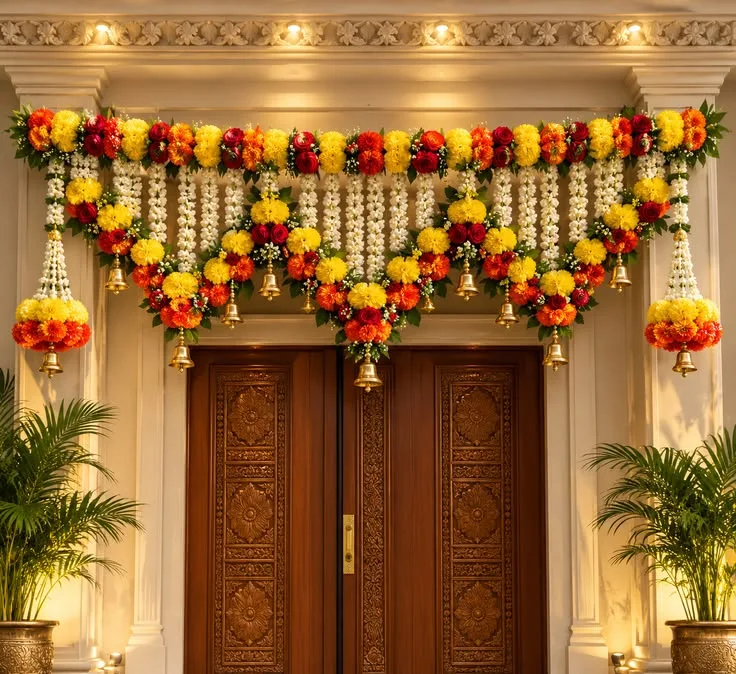
The entrance creates the first impression of a beautifully decorated home and holds immense significance in traditional architectural practices like Vastu Shastra. The main door is considered the "Mouth of Chi" or the primary portal through which cosmic energy, wealth, and opportunities enter the residence. Consequently, elegant entrance styling is critical. Traditional toran and door hangings made from fresh marigold flowers and mango leaves are highly recommended. These natural materials act as protective filters, with mango leaves absorbing negative vibrations and the fiery orange of marigolds purifying the energy crossing into the home.
Vastu Shastra provides precise guidelines regarding the orientation and decoration of the entrance. Ideally, the main door should face North, Northeast, or East to capture the most auspicious energy. For homes with these alignments, floral entrance decoration can be enhanced by specific color palettes; for instance, green and yellow dominate North/Northeast entrances, while yellow is preferred for East-facing doors.
Rangoli designs drawn just outside the threshold serve as a visual and energetic welcome. Traditional and modern entrance combinations often feature a colorful lotus or geometric grid pattern, symbolizing stability and wealth. However, homeowners must be cautious about the materials used. Many commercial rangoli powders are derived from crushed quartz or crystalline silica. Inhalation of fine silica dust (respirable crystalline silica) poses severe respiratory risks and degrades indoor air quality. A safer, eco-friendly alternative involves using natural rice flour, turmeric, or floral petals, which are entirely non-toxic and biodegradable.
Decorative diyas placed symmetrically on either side of the doorway activate the energy of the rangoli. For modern apartments where open flames in common corridors are prohibited or pose a fire risk, warm LED lighting provides an excellent substitute. A glowing entrance, devoid of clutter, old footwear, or broken planters, signals an open invitation to prosperity.
3. Diwali Decoration Ideas for Home Outdoor
Decorating outdoor spaces such as balconies, terraces, and garden pathways demands a careful balance between visual splendor and rigorous electrical safety. Diwali decoration ideas for home outdoor environments often center around extensive lighting networks. When draping balconies or terraces, it is imperative to use outdoor LED string lights that carry an appropriate Ingress Protection (IP) rating. An IP44 rating offers basic resistance against splashing water, but for outdoor spaces fully exposed to dew or unexpected rain, an IP65 rating is highly recommended to prevent short circuits.
Safe diya placement is a critical component of outdoor styling. Clay diyas should be positioned on stable, heat-resistant surfaces away from dry plants, synthetic fabrics, or wind currents. Decorative lanterns made of metal or glass can shield flames from the wind while casting intricate shadows along an entrance pathway decoration. For outdoor rangolis, natural flower petals are vastly superior to powders, as they are less likely to be blown away and do not create a sweeping hazard the following day.
Electrical safety must dictate all outdoor lighting installations. Using uncertified, cheap roadside string lights is the leading cause of festive electrical fires due to poor insulation and substandard wiring. Homeowners should ensure that all electrical accessories comply with the Bureau of Indian Standards (BIS). Power cords should bear the IS 694 mark for flexible cables, and plugs should conform to IS 1293.
Furthermore, calculating electrical loads prevents catastrophic circuit overloading. A standard Indian household extension board is typically rated for either 6 Amperes or 16 Amperes. Overloading these sockets with multiple high-wattage decorative lights alongside regular appliances causes the internal wiring to overheat, melt, and ignite.
Circuit Load Limits | Maximum Safe Wattage Capacity | Common Festive Lighting Draw |
6A Wall Socket | ~1,380 Watts (at 230V) | 10 LED strings = ~80 Watts |
16A Wall Socket | ~3,680 Watts (at 230V) | 4 Halogen Floodlights = ~600 Watts |
Danger Threshold | Daisy-chaining extension boards | Mixing irons/heaters with lights |
Data synthesized from standard electrical safety guidelines.
To ensure absolute safety, homeowners must utilize surge protectors, avoid daisy-chaining multiple extension boards, and confirm that their home’s Residual Current Circuit Breaker (RCCB) is functioning properly (typically a 30mA rating) to prevent severe electric shocks in damp outdoor areas.
4. Diwali Decor Ideas Living Room
The living room serves as the epicenter of family gatherings and guest entertainment during the festival, necessitating a design that is comfortable, elegant, and welcoming. Festive living room styling relies heavily on the nuanced application of layered lighting. Rather than depending on stark, glaring ceiling fixtures, introducing warm ambient lighting transforms the spatial atmosphere.
Understanding lighting science is essential for a professional aesthetic. Correlated Color Temperature (CCT), measured in Kelvin (K), dictates the warmth of the light. For a cozy, inviting living room, a CCT between 2700K and 3000K (warm white) perfectly mimics the glow of traditional oil lamps. However, CCT must be paired with a high Color Rendering Index (CRI). CRI measures how accurately a light source reveals the true colors of objects compared to natural sunlight, on a scale of 0 to 100. To ensure that decorative cushions, throws, and floral arrangements appear vibrant and true to life, lighting fixtures with a CRI of 90 or above are essential. Furthermore, checking the specific 'R9' value—which measures the rendering of deep reds—guarantees that traditional red fabrics and human skin tones look rich and flattering.
Lighting Metric | Definition | Ideal Festive Range | Impact on Living Room Decor |
CCT (Color Temperature) | Appearance of the light itself (warm vs. cool). | 2700K – 3000K | Creates a cozy, relaxing, sunset-like ambiance. |
CRI (Color Rendering Index) | Accuracy of color representation under the light. | 90+ | Makes traditional fabrics, wood, and artwork look vibrant. |
R9 Value | Specific rendering capability for deep red tones. | High (Positive value) | Enhances skin tones and the richness of maroon/red textiles. |
To calculate the necessary brightness, decorators use the lumens per square foot formula. While a standard living room generally requires 15 to 20 lumens per square foot for relaxation, festive setups may demand slightly more brightness to highlight specific decor zones. For example, a 200-square-foot living room would require approximately 3,000 to 4,000 total lumens, distributed across multiple low-wattage LED lamps, fairy lights, and accent fixtures to avoid harsh glare.
Accent walls can be beautifully highlighted using cascading curtain lights. When draping lights near windows, safety distances from fabrics must be maintained. Decorative candles and diyas should be securely anchored on a central coffee table, utilizing a heavy brass or wooden tray to protect the furniture surface and contain any stray wax or oil. Traditional and modern furniture styling can be harmonized by introducing festive colour combinations—such as teal and gold or magenta and mustard—through temporary upholstery updates, throws, and accent rugs.
5. Traditional Diwali Decorations
Traditional Diwali decorations remain the spiritual and visual cornerstone of the festival. When integrated thoughtfully, these elements can be seamlessly combined with contemporary interior design to create spaces that are sophisticated yet deeply rooted in cultural heritage.
Brass and clay diyas are the most recognizable symbols of the festival. Beyond their aesthetic appeal, the choice of illumination carries significant implications for indoor air quality (IAQ). Modern households frequently use synthetic paraffin candles; however, rigorous environmental studies reveal that paraffin wax combustion releases high levels of particulate matter (PM2.5), volatile organic compounds (VOCs), nitrogen oxides (NOx), and formaldehyde. In contrast, traditional clay diyas utilizing clarified butter (ghee) or mustard oil demonstrate significantly cleaner emission profiles. Ghee lamps, in particular, produce lower carbon monoxide emissions and drastically reduced PM2.5 levels, supporting their ancient reputation as purifying elements for the home environment.
Illumination Source | Particulate Matter | VOCs & Formaldehyde | Overall Indoor Air Quality Impact |
Paraffin Wax Candles | Very High | High | Poor; contributes to respiratory irritation. |
Ghee (Clarified Butter) Diya | Low | Minimal | Excellent; traditionally considered purifying. |
Mustard Oil Diya | Moderate | Low | Good; stable thermal combustion. |
Emission profiles based on comparative indoor air quality combustion studies.
Decorative brass objects, such as antique lamps, bells, and urlis, add a layer of timeless elegance to any room. According to Vastu Shastra, placing a brass urli filled with clean water, floating marigold flowers, and rose petals in the Northeast (Ishanya) or North zones of the home harmonizes the water element and attracts prosperity.
Traditional Indian festive colour palettes can be further introduced through ethnic fabrics draped over consoles or used as wall hangings. The strategic placement of these traditional torans and brass artifacts ensures that the modern home retains a profound connection to its ancestral roots.
6. Diwali Home Decor Ideas DIY
For individuals and families who enjoy personalizing their living spaces, engaging in DIY decoration projects offers creative, budget-friendly, and highly sustainable alternatives to store-bought plastic decor. Practical DIY decoration ideas allow homeowners to upcycle materials, thereby reducing the ecological footprint of their festive celebrations.
Handmade Lanterns and Glass Jars: Traditional paper lanterns (Akash Kandil) can be crafted using vibrant, recycled craft paper, cardboard, and non-toxic adhesives. By incorporating precise geometric cuts, these handmade lanterns cast mesmerizing shadow patterns across the walls. Similarly, decorative glass jars from the kitchen can be washed, painted with translucent glass colors, or tightly wrapped with leftover ethnic fabrics. Placing a safe, battery-operated LED tea light inside instantly transforms these jars into stunning, rustic table centerpieces.
DIY Rangoli and Eco-Friendly Materials: As noted, avoiding synthetic silica powders is crucial for respiratory health. A DIY rangoli can be easily created using natural pantry ingredients: rice flour for white, turmeric for yellow, and dehydrated beetroot powder for deep red.
Recycling Floral Waste (Bio-Enzymes): One of the most innovative and environmentally responsible DIY practices involves managing post-festival floral waste. Instead of discarding wilted marigold flowers or traditional torans into municipal waste or water bodies—where they decompose anaerobically and release methane—families can ferment this organic matter. Mixing floral waste with jaggery and water in an airtight container for several weeks produces a natural, citrus-scented bio-enzyme. This eco-friendly liquid can subsequently be used as a potent, chemical-free household floor cleaner, closing the sustainability loop.
7. Diwali Decoration Ideas for School
Decorating educational spaces presents unique challenges. The primary focus must shift strictly toward child safety, interactive creativity, and environmentally responsible decoration. Diwali decoration ideas for school environments mandate the absolute prohibition of open flames, oil diyas, and glass objects that pose shattering risks.
Safe LED Lighting and Photobiological Safety: When utilizing lights for classroom decoration, schools must employ safe LED lighting. It is vital to recognize that not all LEDs are safe for developing eyes. The International Electrotechnical Commission (IEC) standard 62471 evaluates the photobiological safety of lamps, specifically assessing the "Blue Light Hazard" which can cause retinal stress and visual fatigue. Schools should exclusively purchase LED string lights classified as Risk Group 0 (RG0 - Exempt) or Risk Group 1 (RG1 - Low Risk), ensuring that students are entirely safe from harmful optical radiation.
Student-Created Festive Crafts: Teachers can facilitate engaging craft sessions where students create handmade paper flower decorations, paint unlit terracotta diyas with non-toxic acrylics, and construct vibrant paper lanterns. Designing decorative bulletin boards that showcase these student-created festive crafts instills a sense of pride and cultural appreciation. Furthermore, organizing eco-friendly rangoli competitions using colored rice or flower petals teaches children collaborative design while emphasizing the importance of celebrating without toxic chemicals or polluting firecrackers.
8. Modern Luxury Diwali Home Decoration Ideas
For premium residential spaces, modern luxury Diwali home decoration ideas eschew overwhelming clutter in favor of sophisticated, curated elegance. Minimalist festive interiors focus on negative space, allowing a few high-impact designer decorative pieces to command attention.
In a luxury setting, contemporary lighting fixtures with elegant metallic finishes—such as brushed brass, matte gold, or rose copper—seamlessly bridge the gap between modernity and tradition. Premium living room styling often features bespoke luxury floral arrangements utilizing exotic blooms like orchids, tuberoses, and imported lotuses displayed in crystal vases, rather than standard marigold garlands.
Modern accent walls can be transformed using high-end, water-based wood lacquers and low-VOC polyurethane (PU) finishes. These advanced coatings offer a flawless, glossy, or matte finish to wooden panels and furniture without releasing the toxic fumes associated with traditional solvent-based varnishes. By prioritizing indoor air quality and utilizing sustainable, environmentally friendly finishes, modern design can successfully maintain the traditional spirit of Diwali while upholding the rigorous standards of contemporary luxury living.
9. Diwali Home Decoration Tips from Expert Sewa
Achieving a flawless, magazine-quality festive interior requires more than just purchasing beautiful objects; it demands a deep understanding of spatial dynamics, architectural flow, and structural harmony. As a highly knowledgeable professional home decoration and improvement brand, Expert Sewa provides elite, expert-level recommendations for transforming residential spaces.
Interior Space Planning and the Brahmasthan: Drawing upon advanced Vastu architectural geometry, Expert Sewa emphasizes the activation of the Brahmasthan. This zone represents the exact geometric center of the home, determined by dividing the floor plan into a 3x3 grid or 64 squares; the central intersection is the heart of the residence. The Brahmasthan acts as a cosmic distribution point, radiating vital energy (prana) outward to all eight directions. For optimal festive ambience and household harmony, this central courtyard or living area must remain entirely open, structurally unburdened, and flooded with natural or warm artificial light. Expert Sewa advises against placing heavy furniture, structural pillars, or dark-colored rugs in this zone, as blockages here can manifest as stagnation in wealth and health.
Lighting Design and Wall Finishes: Expert Sewa’s approach to lighting design involves sophisticated layering. A combination of overhead ambient lighting, focused task lighting for dining areas, and soft accent lighting for architectural features ensures a dynamic visual experience. Furthermore, Expert Sewa advocates for the application of premium wall finishes that are strictly low-VOC, ensuring that the home is not only visually striking but environmentally safe and breathable for large family gatherings.
Decoration Placement, Furniture Arrangement, and Durability: Furniture arrangement should facilitate the smooth flow of foot traffic, ensuring that guests are never forced to navigate hazardous obstacle courses near open flames or electrical cords. Strategic decoration placement involves anchoring the space with a central natural fiber rug and utilizing vertical planes—such as damage-free floating shelves—to display diyas and artifacts safely out of reach of children and pets. By focusing on safety and durability, Expert Sewa ensures that the festive setup remains pristine, secure, and beautiful throughout the entire holiday season.
Frequently Asked Questions About Diwali Home Decor Ideas
1. What are the best Diwali home decor ideas? The most effective ideas harmonize traditional motifs with modern architectural styling. Utilizing natural marigold torans at the entrance, placing a brass urli with floating candles in the Northeast zone, layering warm white LED lighting (2700K), and updating living room textiles with high-quality, non-flammable fabrics provide a spectacular aesthetic upgrade.
2. How can I decorate my home for Diwali simply? Simplicity in decoration is achieved by establishing strong focal points. A well-designed floral rangoli at the main door, a curated tray of traditional clay diyas on a coffee table, and cascading fairy lights around a single accent wall offer maximum visual impact without creating spatial clutter.
3. What are the best Diwali decoration ideas for home entrance? The entrance sets the energetic tone for the home. Hang a fresh mango leaf and marigold toran to filter negative energy. Draw an inward-facing rangoli using natural rice flour (avoiding toxic silica dust), and frame the doorway with a pair of symmetrically placed, oil-filled clay diyas to welcome prosperity.
4. How can I decorate my living room for Diwali? Transform the living room by introducing festive cotton or silk cushion covers in rich colors like saffron and emerald. Implement layered lighting using high CRI (>90) fixtures to ensure colors pop naturally. Anchor the seating area with a warm-toned rug and place a metallic brass centerpiece on the main table.
5. What are the best outdoor Diwali decoration ideas? Outdoor decorations must prioritize durability and safety. Utilize IP65-rated waterproof LED string lights for balconies and gardens. Place traditional lanterns to shield flames from the wind, and ensure all electrical extension cords are heavy-duty and strictly avoid overloading standard 6A sockets.
6. How can I decorate my home for Diwali on a low budget? A low budget does not mean compromising on style. Embrace DIY projects such as crafting paper lanterns, painting recycled glass jars to serve as tea light holders, and upcycling old ethnic sarees into decorative table runners or wall draperies.
7. Which colours are best for Diwali home decoration? Vastu and traditional aesthetics favor warm, auspicious colors. Deep reds, vibrant yellows, saffron, emerald greens, and rich golds are ideal. These colors not only reflect the warmth of the diya flames but are deeply associated with the energies of abundance and celebration.
8. How can I decorate my home with traditional Diwali decorations? Integrate traditional items with intentional placement. Use brass artifacts, bells, and urlis as statement pieces. Light traditional ghee or mustard oil clay diyas, which produce significantly less indoor air pollution than paraffin candles, and utilize fresh jasmine or marigold flowers to bring natural fragrance into the home.
Conclusion
The festival of lights provides an unparalleled opportunity to rejuvenate, cleanse, and elevate our residential spaces. By integrating the best Diwali home decor ideas—ranging from budget-friendly DIY crafts and safe, eco-conscious outdoor lighting to modern luxury finishes and Vastu-aligned space planning—homeowners can craft environments that radiate profound warmth, prosperity, and joy. Whether focusing on an inviting entrance, a cozy living room, or ensuring that the home's Brahmasthan remains energetically open, maintaining a careful balance between aesthetic beauty, environmental sustainability, and rigorous electrical safety guarantees a flawless and memorable celebration.
For those looking to permanently elevate their living spaces beyond temporary seasonal decorations, Expert Sewa provides trusted, professional interior design and residential improvement services. From comprehensive architectural space planning and customized lighting design to the application of premium, low-VOC wall finishes, homeowners and design enthusiasts are encouraged to explore Expert Sewa's professional services. Partner with Expert Sewa today to transform your everyday living space into a breathtaking, luxury sanctuary.