
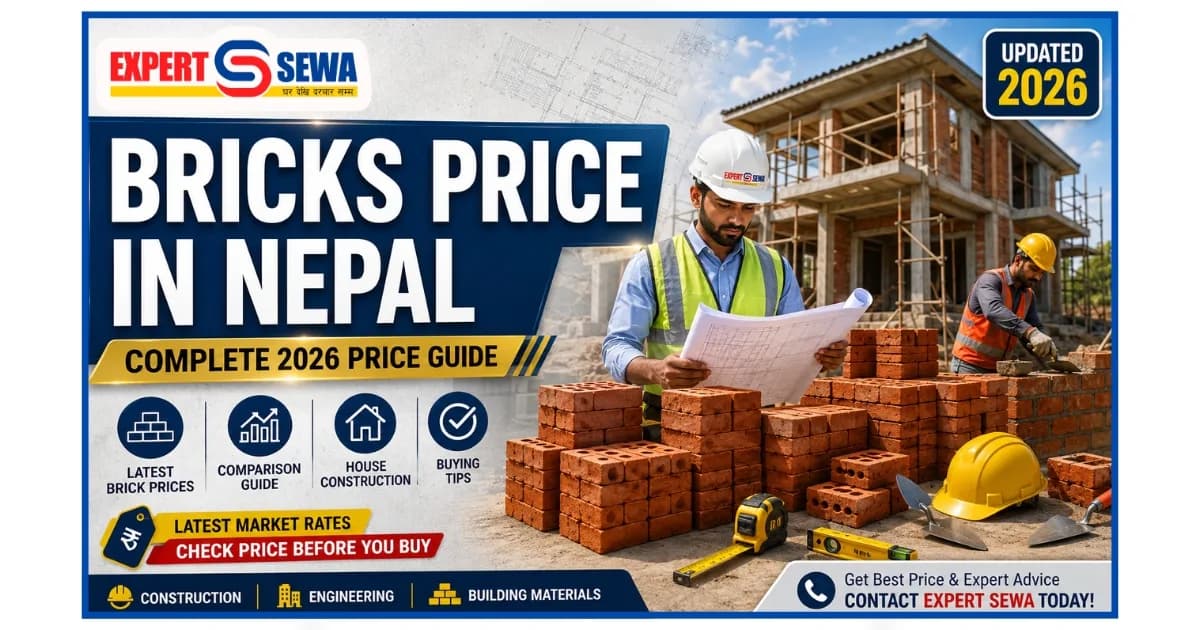
Bricks Price in Nepal (2026): Complete Price Guide, Types, Quality & Buying Tips
1. Introduction
Before laying the foundation stone for any new building, mapping out your budget for core structural items is a critical first step. In structural engineering and residential building, wall assembly elements make up a substantial share of total material costs. As masonry options grow more diverse, tracking the prevailing brick price in Nepal has become standard practice for anyone managing a development budget.
The building sector faces shifting economic landscapes. Recent market updates show that overall building materials in Nepal rose significantly, with traditional red bricks seeing wholesale spikes driven by fuel adjustments and kiln operating logistics. Relying on outdated figures from previous years can lead to unexpected budget shortfalls.
This exhaustive guide provides accurate current market price ranges for different material classifications, details on-site quality testing methods, and outlines the calculation steps needed to accurately determine your building requirements. This data will help you optimize your procurement process, whether you are coordinating a single-family home or a multi-story commercial complex.
2. Why Bricks are Important in House Construction
Bricks have long served as a primary element in regional masonry, adapting well to diverse local environments. Selecting high-quality building units affects several long-term structural characteristics:
· Compressive Strength and Structural Integrity: First-class units provide the load-bearing strength needed to support permanent dead loads and shifting live loads, forming a robust system when integrated with reinforced concrete framing.
· Seismic Deflection Resilience: Properly fired masonry works alongside reinforced concrete pillars to absorb structural shear stress, which is critical for safety in active seismic zones like Nepal.
· Thermal Performance: Fired red clay units act as a natural thermal mass, slowing heat transfer to keep interiors warmer in winter and cooler during summer peak temperatures.
· Moisture Control: High-grade units resist water penetration, protecting interior plaster from dampness and preventing the growth of structural mold.
3. Bricks Price in Nepal (2026): Master Price Matrix
The baseline cost data below reflects wholesale warehouse orders across major urban centers, including Kathmandu, Lalitpur, Bhaktapur, Pokhara, Chitwan, and Butwal.
Estimated 2026 Market Prices
Material Classification | Approximate Size Dimensions (mm) | Estimated Price Range (NPR / Piece) | Primary Structural Application |
First-Class Red Bricks (Aval) | 230 x 110 x 55 | NPR 18 – NPR 25 | Permanent structural walls, load-bearing masonry |
Second-Class Red Bricks | 230 x 110 x 55 | NPR 14 – NPR 18 | Partition framing, compound wall boundaries |
Third-Class Red Bricks | Varies by producer | NPR 10 – NPR 13 | Temporary site enclosures, non-structural works |
Machine-Made / Chinese Bricks | 240 x 115 x 53 | NPR 22 – NPR 28 | Exposed architectural facades, premium finishes |
Fly Ash Bricks | 230 x 110 x 70 | NPR 15 – NPR 25 | Eco-friendly load partitions, lightweight frames |
AAC Blocks (4-inch Standard) | 600 x 200 x 100 | NPR 145 – NPR 180 | Internal space dividers, high-rise infill walls |
AAC Blocks (6-inch Standard) | 600 x 200 x 150 | NPR 210 – NPR 260 | Residential exterior walls, high-rise infill walls |
AAC Blocks (8-inch Standard) | 600 x 200 x 200 | NPR 280 – NPR 350 | Perimeter thermal boundaries, external blocks |
Hollow Concrete Blocks | 390 x 190 \ 190 | NPR 70 – NPR 90 | Industrial frame enclosures, boundary fencing |
Solid Concrete Blocks | 390 x 190 x 100 | NPR 45 – NPR 65 | Foundation adjustments, structural plinths |
Interlocking Soil-Cement Bricks | 250 x 125 x 100 | NPR 45 – NPR 65 | Fast-assembly walls, low-cost housing units |
Eco Bricks (Stabilized) | Varies by factory | NPR 20 – NPR 32 | Eco-conscious residential designs |
Decorative Facing Bricks | Varies by finish | NPR 35 – NPR 65 | External accents, visual cladding panels |
Market Volatility Clause: Material cost projections depend heavily on changing fuel costs, regional clay availability, local labor rates, and seasonal supply changes. Final delivered estimates can change based on the location of your plot and accessibility. We highly recommend requesting a formal, itemized Bill of Quantities (BOQ) from our engineering team before finalizing your project budget.
4. Average Brick Price Breakdown Per Piece, 100, and 1,000 Bricks
To simplify budget planning, we break down costs by standard procurement batch sizes.
Bulk Purchase Cost Projections
The table below shows price estimates including regional freight routing to drop points within a 15-kilometer radius of a production kiln.
Material Class | Unit Cost (NPR) | Cost Per 100 Units (NPR) | Cost Per 1,000 Units (NPR) |
First-Class Red Bricks | NPR 22 | NPR 2,200 | NPR 22,000 |
First-Class Red Bricks | NPR 25 | NPR 2,500 | NPR 25,000 |
Machine-Made (Chinese) | NPR 26 | NPR 2,600 | NPR 26,000 |
Fly Ash Units | NPR 18 | NPR 1,800 | NPR 18,000 |
Associated Logistics Charges
· Average Transport Cost Factors: Shipping materials from regional hubs (such as the Terai plains) to the Kathmandu Valley adds roughly NPR 3.00 to NPR 6.00 per brick to cover rising diesel prices and highway tolls.
· Loading and Unloading Fees: Standard handling fees range between NPR 0.80 and NPR 1.50 per unit, depending on how far materials must be moved manually if truck access to the site is limited.
5. Types of Bricks Available in Nepal: A Deep Dive
Choosing the right material requires evaluating the performance characteristics, structural benefits, and drawbacks of each option.
1. Traditional Fired Clay Bricks (Red Bricks)
· Production Method: Formed from local topsoil clay, dried in the sun, and fired in traditional Fixed Chimney Bull’s Trench Kilns (FCBTK) or Zig-Zag kilns.
· Advantages: Widely available across local markets, easy for masons to handle, and offers solid structural density.
· Disadvantages: Dimensions can vary between kilns, and structural strength depends on the quality of the raw clay source.
· Common Applications: Load-bearing external walls, infill panel masonry, and foundation plinths.
· Average Lifespan: 60 to 100 years when properly protected from groundwater dampness.
2. Machine-Made / Chinese Bricks
· Production Method: Extruded under vacuum pressure in automated manufacturing plants and fired uniformly in high-temperature tunnel kilns.
· Advantages: Exceptional dimensional accuracy with minimal variation, smooth exterior finish, low water absorption, and high Compressive Strength.
· Disadvantages: Higher upfront material cost per piece compared to standard clay units.
· Common Applications: Exposed facade brickwork, feature walls, exterior landscaping, and high-end residential builds.
· Average Lifespan: 80 to 120 years without exterior plaster coatings.
3. Fly Ash Bricks
· Production Method: Formed by hydraulic compression mixing class C or F fly ash, cement, sand, and water, then moisture-cured rather than kiln-fired.
· Advantages: Eco-friendly footprint that uses industrial byproducts, precise dimensions, and good resistance to efflorescence (salt staining).
· Disadvantages: Lower structural shear strength compared to first-class fired clay bricks, making them less suitable for main load-bearing walls.
· Common Applications: Framed structural partition walls, multi-story infill systems, and boundary walls.
· Average Lifespan: 50 to 70 years in dry conditions.
4. Autoclaved Aerated Concrete (AAC) Blocks
· Production Method: Manufactured by mixing quartz sand, calcined lime, gypsum, cement, water, and an aluminum expansion agent, then steam-cured under high pressure in autoclaves.
· Advantages: Extremely lightweight (reduces structural dead load by up to 60%), large size speeds up installation, and provides excellent thermal and acoustic insulation.
· Disadvantages: Requires specialized polymer adhesive mortars rather than standard cement mixes, and requires careful handling to prevent corner breakage.
· Common Applications: High-rise commercial columns, interior space partitions, and insulation retrofits.
· Average Lifespan: 60 to 80 years when properly plastered with waterproof coatings.
5. Hollow and Solid Concrete Blocks
· Production Method: Molded from a mix of ordinary Portland cement, sand, gravel, and water using mechanized vibrating press tables.
· Advantages: High load capacity per block, faster installation due to large dimensions, and internal cavities allow for vertical rebar reinforcement.
· Disadvantages: Poor thermal insulation properties, and heavy units increase handling effort during construction.
· Common Applications: Industrial warehouses, commercial buildings, compound fences, and structural foundation elements.
· Average Lifespan: 70 to 90 years.
6. Interlocking Soil-Cement Bricks
· Production Method: Produced by compressing a damp mix of local soil, 8–10% cement, and sand in a manual or motorized hydraulic press block machine.
· Advantages: Interlocking joints remove the need for mortar in vertical seams, speeding up installation and lowering material costs.
· Disadvantages: Requires strict quality control during production to prevent size defects that disrupt block alignment.
· Common Applications: Low-cost housing initiatives, single-story residential projects, and boundary walls.
· Average Lifespan: 40 to 60 years.
6. Key Factors Affecting Brick Prices in Nepal
Understanding what drives changes in material costs helps buyers time their purchases and manage budgets effectively:
· Raw Fuel Costs: Traditional kilns rely heavily on imported coal and diesel. Fluctuations in global fuel prices directly affect firing and transport costs, which are passed on to the consumer.
· Seasonal Supply Dynamics: The brick industry operates seasonally, with production active from late autumn through spring. Prices often rise during the peak winter construction surge due to high demand and tightening supplies.
· Logistics and Site Accessibility: Sourcing bricks from large Terai production hubs keeps base costs lower, but highway freight charges add to the final price when delivering to mountain valley projects.
· Regulatory and Environmental Policies: Stricter local emission standards require kilns to upgrade to cleaner firing technologies, which increases initial equipment costs for producers.
· Urbanization and Local Demand: Rapid development in major metropolitan areas keeps demand high, widening the price gap between city centers and rural production zones.
7. Brick Quality Guide: How to Test Bricks On-Site
To protect your investment, you should test material quality before unloading a shipment on site. Use these simple field tests to check quality:
Field Quality Assessment Protocols:
You can verify the structural standard of building units using three practical field methods. Start with a visual geometry check to confirm the units possess precise 90° straight edges and remain entirely free from surface fractures, deep cracks, or size defects. Subsequently, utilize an acoustic ringing test by striking two samples together; a clear, metallic ringing sound serves as a primary indicator of uniform firing and density. Finally, perform a surface hardness scratch test with a fingernail or sharp tool. A superior-grade unit will resist developing a deep indentation, proving its long-term durability and resistance to wear. These rapid inspections facilitate a reliable initial evaluation of material integrity prior to formal laboratory validation.
· Visual Geometry Check: Inspect a sample for uniform size, straight edges, and flat surfaces. Variations greater than 5mm require thicker mortar layers, which increases your cement costs.
· Color Uniformity: A deep copper or cherry-red color indicates uniform firing throughout the brick. Pale, yellowish-orange surfaces indicate under-fired clay, which breaks easily under load.
· Acoustic Ringing Test: Strike two bricks together firmly. A high-quality, well-fired unit will produce a clear, metallic ringing sound, while under-fired or cracked units produce a dull, hollow thud.
· Surface Hardness Scratch Test: Attempt to scratch the brick surface with a sharp steel nail or fingernail. High-quality units resist scratching and will not shed loose sand or clay particles.
· Field Drop Test: Drop a sample brick from a height of approximately one meter onto flat ground. A structurally sound unit should survive the impact without cracking or breaking into pieces.
· Water Absorption Test: Weigh a dry brick, then submerge it in water for 24 hours. Weigh it again; a first-class brick should absorb less than 20% of its dry weight. Higher absorption indicates a porous structure that can trap moisture and weaken over time.
8. Bricks vs AAC Blocks vs Concrete Blocks: Comparative Analysis
Choosing the right wall element involves balancing structural weight, installation speed, and overall cost:
Technical Specification | First-Class Red Bricks | Autoclaved Aerated Concrete (AAC) | Solid Concrete Blocks |
Compressive Strength | 3.5 – 5.0 N/mm2 | 3.0 – 4.5 N/mm2 | 7.5 – 10.0 N/mm2 |
Dry Density Weight | ~ 1800 kg/m3 | ~ 650 – 750 kg/m3 | ~ 2200 kg/m3 |
Thermal Conductivity | High (0.81 W/m·K) | Very Low (0.16 W/m·K) | Extremely High (1.30 W/m·K) |
Fire Deflection Endurance | Up to 2 hours | Up to 4–6 hours | Up to 2 hours |
Assembly Installation Speed | Baseline standard | 3x faster than bricks | 2x faster than bricks |
Mortar Requirements | High cement volume | Minimal polymer adhesive | Standard cement mortar |
Earthquake Shock Response | Heavy weight increases forces | Lightweight minimizes lateral forces | Rigid heavy mass |
Long-Term Efflorescence | Vulnerable to salt staining | High resistance | Low resistance |
Total Wall Construction Cost | Baseline cost metric | 15–25% savings on plaster/labor | Balanced cost profile |
9. How Many Bricks Are Needed to Build a House? Estimation & Calculations
To help you plan, our engineering team shares the formulas used to calculate total brick requirements for typical residential floor plans:
Basic Engineering Estimation Formula
For a standard 9-inch thick brick wall using standard dimensions (230 x 110 x 55 mm), we use a baseline factor of 50 bricks per square meter of wall face area, plus a 5–10% safety buffer for on-site cutting waste.
Estimated Material Requirements by Project Type
For a typical residential house in Nepal, the approximate number of bricks required varies by the size of the home. A 1 BHK house generally requires 7,000–9,500 bricks, making it suitable for small families or single occupants. A 2 BHK house typically needs 12,000–16,000 bricks, depending on the floor area, wall thickness, and design. For a larger 3 BHK house, the requirement increases to approximately 18,000–24,000 bricks. These estimates may vary based on the architectural layout, number of floors, type of brick used, and construction method, but they provide a useful guideline for planning material requirements and estimating construction costs.
· 1 BHK Single-Storey Unit (approx. 500 sq. ft. footprint): Requires 7,000 to 9,500 bricks, assuming standard structural framing.
· 2 BHK Standard Family House (approx. 800 sq. ft. footprint): Requires 12,000 to 16,000 bricks for internal partitions and exterior walls.
· 3 BHK Family Home (approx. 1,200 sq. ft. footprint): Requires 18,000 to 24,000 bricks.
· Double-Storey Residential House (approx. 2,000 sq. ft. total floor area): Requires 25,000 to 35,000 bricks, depending on structural layout and open room designs.
10. Expert Tips for Buying Bricks in Nepal
To ensure a smooth procurement process, follow this structured roadmap from planning to deployment on your plot:
The Material Procurement Roadmap
A systematic brick procurement process helps ensure quality, cost efficiency, and timely delivery.
Phase 1: Evaluation involves obtaining direct quotations from multiple brick kilns to compare prices, quality, and supplier reliability.
Phase 2: Design Validation focuses on verifying that the selected bricks match the project's Bill of Quantities (BOQ), specifications, and construction drawings.
Phase 3: Field Sourcing includes visiting the kiln or supplier to inspect sample bricks and conduct basic quality tests before confirming the order. Finally,
Phase 4: Logistics ensures smooth transportation by planning delivery schedules, preparing the unloading area, and arranging proper on-site storage to prevent damage and maintain construction progress.
1.Kiln Evaluation and Bulk Cost Analysis:Week 1.
Research 2-3 local suppliers or large manufacturing kilns during late autumn or early winter, before peak seasonal demand drives up regional rates.
2.BOQ Optimization and Design Review:Week 2.
Cross-verify your blueprint wall area with the itemized Bill of Quantities (BOQ) from your engineer to ensure a 5-10% transit breakage buffer is properly counted.
3.Sample Field Inspections:Week 3.
Visit the chosen supplier directly to test a random sample from the stack using on-site quality checks before approving full payment or delivery routing.
4.Site Preparation and Scheduled Unloading:Week 4.
Clear narrow access roads for heavy transport trucks, prepare dry elevated storage to prevent moisture saturation, and coordinate manual labor for immediate offloading.
11. Common Mistakes Buyers Make When Purchasing Building Materials
· Prioritizing the Cheapest Rate Over Quality: Choosing lower-grade bricks to save money up front often backfires. Substandard bricks suffer from high breakage rates during transport and require thicker plaster coats to level out uneven walls, increasing your total cement expenses.
· Neglecting the Transit Waste Buffer: Failing to include a 5–10% material buffer for transit breakage can leave your masonry crew short at a critical stage, forcing you to pay premium delivery rates for small emergency orders.
· Ignoring Dimensional Consistency: Buying mismatched batches from multiple small kilns creates uneven wall faces that require extra labor and materials to correct during interior plastering.
· Failing to Confirm Access Site Capabilities: Ordering large 10-wheel transport trucks for narrow urban lanes can leave materials stuck blocks away, incurring significant extra handling and manual portage fees.
12. Why Choose Expert Sewa?
· Vetted Material Supplier Network: We source materials exclusively from certified regional manufacturers who maintain consistent quality and strict dimensional standards.
· Fully Transparent Pricing Structures: Our detailed Bills of Quantities (BOQ) provide transparent pricing with no hidden handling or transport fees during the build.
· Civil Engineering Oversight: Our project engineers supervise on-site material deliveries and perform structural quality checks before installation begins.
· Complete Turnkey Solutions: Expert Sewa manages every phase of your project, from initial soil testing and architectural design to material procurement and final interior completion.
13. Frequently Asked Questions
1. What is the current market price of first-class bricks in Kathmandu?
In 2026, first-class red clay bricks (Aval) in the Kathmandu Valley generally range from NPR 18 to NPR 25 per piece, depending on the source kiln and delivery location.
2. Why are machine-made bricks more expensive than traditional kiln options?
Machine-made bricks offer superior structural strength, low water absorption, and highly consistent dimensions, which reduces the amount of mortar and plaster needed during installation.
3. How many bricks do I need for a standard 1,000 square foot single-story house?
A standard residential build of this scale typically requires between 14,000 and 18,000 bricks, depending on the number of interior rooms and partition wall layouts.
4. Are lightweight AAC blocks cheaper than traditional red bricks?
While AAC blocks have a higher per-piece price, their large size and lightweight structure speed up construction and reduce mortar volume, often lowering overall wall construction costs by 15% to 25%.
5. What causes white powdery patches on newly completed brick walls?
This white staining is called efflorescence. It occurs when soluble salts within low-grade clay or mixing water migrate to the surface as moisture evaporates.
6. How can I easily check brick quality directly at the construction site?
You can perform simple field tests: strike two bricks together to check for a clear metallic ring, drop a sample from one meter to ensure it does not break, and try scratching the surface with a nail to verify hardness.
7. Does the time of year affect brick prices in Nepal?
Yes. Prices typically rise during the peak winter and early spring construction season due to high market demand and tightening supplies.
8. Can I use second-class bricks for load-bearing walls?
We do not recommend using second-class bricks for primary load-bearing structures. They are best suited for non-structural interior partitions or exterior boundary walls.
9. What are the standard dimensions of a building brick in Nepal?
The standard dimensions for a classic first-class building brick are 230 x 110 x 55 mm.
10. Do brick suppliers include delivery and unloading charges in their base quotes?
Base wholesale quotes often cover only factory loading. You should explicitly confirm whether transport and on-site manual unloading are included before signing a contract.
11. What are interlocking bricks, and do they require plastering?
Interlocking bricks feature top and bottom grooves that lock together without mortar joints. Their smooth, uniform finish allows them to be left unplastered for a rustic, exposed-brick look.
12. Are fly ash bricks safe for residential home construction?
Yes. Certified fly ash bricks offer reliable strength and good fire resistance, making them an eco-friendly choice for framed structural partition walls.
13. How much transit breakage should I expect when ordering bricks?
Standard project estimates include a 5% to 10% waste buffer to account for typical edge chipping and breakage during shipping and handling.
14. Can I build a reinforced structural house using hollow concrete blocks?
Yes. Hollow blocks can be reinforced by placing vertical steel rebar through their open cavities and filling them with concrete grout, creating a strong structural wall system.
15. Where are the main brick manufacturing hubs located in Nepal?
Most traditional kilns are concentrated in the Terai region and across parts of the Kathmandu Valley, where high-quality clay deposits are readily accessible.
16. Why do fuel prices affect the cost of bricks?
Brick production relies heavily on fuel for both high-temperature kiln firing and long-distance truck transportation from manufacturing hubs to city jobsites.
17. How long should I soak clay bricks in water before laying them?
Clay bricks should be fully submerged in water for at least 2 hours before use. This prevents the dry clay from absorbing moisture from the fresh mortar, ensuring a strong bond.
18. Can I mix red clay bricks and concrete blocks in the same wall?
We do not recommend mixing different materials in the same wall line. Bricks and concrete expand and contract at different rates, which can lead to structural cracking along the joints.
19. Do commercial banks require material quality certificates for home loans?
Yes. Most financial institutions require detailed engineering drawings and material specifications from a certified builder to verify structural safety before approving a loan.
20. How can I get a precise material cost estimate for my project?
You can contact the engineering team at Expert Sewa. We will review your blueprints and provide a detailed, itemized Bill of Quantities (BOQ) tailored to your specific project.
14. Conclusion & Next Steps
Selecting the right building block requires balancing material costs against structural performance, fire ratings, and thermal properties. While traditional red clay units remain widely accessible across Nepal, alternatives like machine-made bricks and lightweight AAC blocks present reliable modern pathways to speed up construction and lower structural dead weight.
Because material prices fluctuate regularly based on fuel dynamics and market variables, getting an updated quote before procurement is essential.
Streamline Your Material Procurement with Expert Sewa
Avoid the stress of market price fluctuations and variable material quality. Our engineering team at Expert Sewa provides transparent, itemized material cost calculations and connects you with verified manufacturing networks across Nepal.
[Click Here to Request an Accurate Material Quote for Your Project]